Our History
Origins of Freemasonry
Craft Freemasonry traces its origins to medieval Europe, with documented evidence emerging in the late fourteenth and early fifteenth centuries through early Masonic manuscripts that reflect operative masonry in England. The initiation of Elias Ashmole in 1646 marked the transition from operative to speculative Freemasonry, as men of learning and social standing began joining the fraternity. By the late seventeenth and early eighteenth centuries, Freemasonry had gained prominence among the intellectual elite, culminating in the formation of the Grand Lodge of London and Westminster on 24 June 1717 – the first organised Masonic body and the foundation of modern Freemasonry.
In 1723, Dr James Anderson compiled Anderson’s Constitutions, codifying the philosophical and organisational framework of Freemasonry and shaping its global development. Internal divisions soon emerged between the “Moderns” and the “Ancients”, two rival Grand Lodges that differed in ritual and governance. Their rivalry persisted for nearly sixty years until 1813, when a spirit of compromise led to their unification as the United Grand Lodge of England (UGLE), harmonising Masonic practice and symbolism under one governing authority.
Following this union, Freemasonry expanded rapidly across the world, carried by the influence of British trade and colonial presence. Lodges were established in distant regions, including the Eastern Archipelago, where Freemasonry took root and evolved within local contexts. From its beginnings in medieval stonemasons’ guilds to its transformation into a universal fraternity of moral and philosophical pursuit, the journey of Freemasonry reflects a continuous evolution of tradition, unity, and enlightenment across centuries and continents.
Freemasonry in the British-termed Eastern Archipelago took root in eighteenth-century Sumatra, where British East India Company (BEIC) officials established lodges at Fort Marlborough in Bengkulu. Pinang followed in the early nineteenth century as an initial proving ground, before the centre of gravity shifted to Singapore in the mid-nineteenth century with the creation of a recognised provincial framework. Pinang resurfaced in the last quarter of the century, followed by a District encompassing three jurisdictions and numerous halls.
Freemasonry in Sumatra developed during the British East India Company’s tenure at Fort Marlborough in Bengkulu, where officers, engineers, and administrators introduced the Craft into colonial society. Central to this history was John MacDonald (1759–1831), a BEIC captain and surveyor who became Provincial Grand Master of Sumatra in 1793. A man of notable lineage and scholarship, MacDonald was active in both the Asiatic Society and early Masonic philanthropy. Under his leadership, several lodges were established in Bengkulu, including Lodge No. 1, Marlborough (later Rising Sun) Lodge, and the Lodge of Unanimity and Industry. These lodges reflected both the expansion of British influence and the fraternal networks of the time, although many became inactive by the early nineteenth century. After MacDonald’s departure in 1796, leadership passed to local figures such as Bartholomew Hartley, and later to Henry Robert Lewis (c.1788–1877), who succeeded MacDonald as Provincial Grand Master in 1821.
Lewis, of mixed English and Indonesian heritage, was a respected magistrate fluent in Bengkulu Malay and instrumental in codifying local legal statutes. His long but largely symbolic stewardship of the Province marked the twilight of Freemasonry in Sumatra. Following the Anglo-Dutch Treaty of 1824, which saw Britain cede Bengkulu to the Dutch in exchange for Melaka, English Masonic activity on the island ceased. Rising Sun Lodge was officially erased in 1862, and by then, Freemasonry’s vitality in Sumatra had faded entirely, eclipsed by the growing prominence of Pinang.
The introduction of Freemasonry in Pinang emerged alongside the island’s transformation into a British stronghold under the East India Company in the late 18th century. When Captain Francis Light secured Pinang from the Sultan of Kedah in 1786, the influx of British administrators, merchants, and officers brought with them the fraternal traditions of Masonry. Figures such as Philip Dundas, the first Governor of Pinang, and Sir Stamford Raffles, who assisted in establishing its early administration, were instrumental in fostering a Masonic presence that reflected the island’s growing cosmopolitan character. As Pinang flourished into a hub of commerce and culture within the British Empire, it became a natural gathering place for Freemasons – men of enterprise and enlightenment – whose ideals of fraternity and moral advancement found fertile ground amidst the island’s diverse and dynamic society.
The first recorded instance of Freemasonry in Pinang coincided with the establishment of the British Presidency under Governor Philip Dundas and the arrival of Sir Stamford Raffles. On 16 August 1806, a group of brethren commemorated the anniversary of H.R.H. as Grand Master of Masonry with a dinner and toasts celebrating the Craft, virtue, and fellowship among Masons. This early activity reflected the desire to practice Masonic precepts in the absence of an official lodge, laying the groundwork for the formal establishment of Neptune Lodge.
A formal petition for the creation of Neptune Lodge was sent to London on 31 May 1808 by twelve prominent residents of Pinang, including Thomas McQuoid, Andrew Burchet Bone, William Robinson, Samuel Stewart, and John Rodyk. The petition requested permission to establish a lodge vested with the full privileges of the Craft and proposed the name “Neptune Lodge.” The lodge received its warrant on 6 September 1809 from Prince John, Duke of Atholl, Grand Master of the Grand Lodge of England. The first meeting was held on 10 September 1810, with Thomas Robinson serving as the Founding Master and Rodyk as Secretary pro tempore. Neptune Lodge held frequent meetings, reflecting both the transitory nature of the brethren and the administrative needs of the growing colonial settlement.
Following the dormancy of the first Neptune Lodge around 1813–14, Lodge Humanity with Courage No 826 was consecrated in 1822. Its first Worshipful Master was Richard Brinsley Smith, and it continued under Hugh Stewart until 1827. Stewart recognized that the lodge had operated contrary to Grand Lodge regulations, being a military lodge with civilian members, and therefore took the initiative to dissolve Humanity with Courage in order to revive Neptune Lodge No 441. This careful revival demonstrated a commitment to Masonic principles and proper governance, reflecting the ongoing efforts to stabilize the Fraternity in a colonial setting.
The revived Neptune Lodge, led by Hugh Stewart as Worshipful Master with Edward Tanner and William Hall as Wardens, held regular meetings and was eventually renumbered No 293 in 1832. The lodge’s fortunes, along with those of Humanity with Courage, illustrate the challenges of sustaining Freemasonry in Pinang, including transience, factionalism, and logistical difficulties. Despite these challenges, the lodges provided a focal point for Masonic fellowship and moral practice, marking Pinang as an early center for Freemasonry in the Straits Settlements and a laboratory for the Fraternity’s adaptation to British colonial administration.
Freemasonry in Singapore took root in the mid-19th century, largely due to the efforts of W Bro John Colson Smith, who brought extensive Masonic experience from Pinang. Initiated in Lodge Social Friendship No 326 in Chennai, India, and a member of several appendant orders including the Royal Arch, Rose Croix, and Knight Templar, Smith joined Neptune Lodge No 441 in Pinang in 1828. Over the next fifteen years, he played a key role in guiding and stabilising Freemasonry in Pinang, leveraging his reputation, education, and leadership to embed the Craft within the colonial mercantile and administrative networks of the Straits Settlements. Correspondence from the period indicates early attempts by Singapore brethren to petition for a lodge, though these efforts did not materialize until Smith’s relocation to the island.
In 1844, Smith moved to Singapore to serve as the headmaster of the Singapore Institution Free School, an establishment founded by Sir Stamford Raffles. His presence on the island provided a focal point for the Masonic community, linking the growing settlement’s administrative and social elites with the wider fraternal network of the Straits Settlements. While specific records of lodge activity in Singapore during his tenure are limited, Smith’s leadership and Masonic standing were instrumental in laying the foundations for organised Freemasonry on the island, ensuring that the Craft’s principles and traditions became established alongside the colony’s institutional and educational development.
Freemasonry in Singapore began in earnest with W Bro John Colson Smith, whose experience in Pinang positioned him to lead the foundation of The Zetland Lodge. In 1844, a petition signed by Smith and fifteen other brethren was sent to the United Grand Lodge of England (UGLE), requesting a warrant of constitution for a lodge in Singapore. The lodge, named in honour of Thomas Dundas, 2nd Earl of Zetland, received its warrant on 31 May 1845, and was consecrated on 8 December 1845 at The Masonic Room on Armenian Street, with Smith installed as the first Master, assisted by Bros Charles Andrew Dyce and Thomas Owen Crane as Senior and Junior Wardens. The Zetland Lodge established regular Masonic activity in Singapore and became a central point for the colony’s Freemasons.
The Lodge of Fidelity was Singapore’s second lodge, warranted on 3 April 1858, with W Bro Smith again serving as the Founding Master. The lodge followed a similar petition format to that of The Zetland Lodge and included twenty signatories, many of whom were already members of Zetland Lodge. It met on the last Monday of each month and represented a complementary expansion of Freemasonry in the colony, reinforcing fraternal bonds and providing another platform for Masonic activity. The lodge later amalgamated with The Zetland in the East Lodge around 1863, consolidating the Masonic presence in Singapore.
Following the consolidation, The Lodge of St. George was established with a warrant from Cadogan Lodge No 162, London, and consecrated on 22 June 1867. It included members from The Zetland in the East Lodge and Lodge of Fidelity, with W Bro Felix Henry Gottlieb playing a leading role. This lodge, together with the earlier lodges, solidified the Masonic structure in Singapore, which by then had been formalized under the Provincial Grand Lodge of the Eastern Archipelago in 1858. Through these three lodges, Freemasonry in Singapore transitioned from individual initiative to an organized provincial framework, providing continuity, local governance, and expansion across the region.
Freemasonry returned to Pinang with the establishment of the Prince of Wales Lodge in 1875, marking the island’s reintegration into the Masonic network of the Eastern Archipelago after years of dormancy. The lodge became the fourth in the District Grand Lodge of the Eastern Archipelago, following The Zetland in the East Lodge, Lodge of Fidelity (later amalgamated into Zetland), and The Lodge of St. George. A petition for its charter was sent on 17 April 1875 to the Most Worshipful Grand Master, HRH Albert Edward, Prince of Wales, through W Bro FH Gottlieb and District Grand Master R W Bro WH Read. The lodge was formally drawn from established lodges in the region, ensuring continuity of fraternal connections while reasserting Pinang’s Masonic presence.
The Prince of Wales Lodge’s petitioners included members from The Zetland in the East Lodge, Lodge Zetland 525 in Hong Kong, and The Lodge of St. George No 1152, highlighting the interlinked nature of Freemasonry across the Eastern Archipelago. Bro Robert Carr-Woods, Primus Master of the lodge, had previously been a petitioner at The Zetland Lodge’s founding in Singapore in 1845. By invoking the Prince of Wales in its name, the lodge aligned itself with metropolitan prestige, reflecting how colonial Freemasonry combined local initiative with imperial endorsement to strengthen regional Masonic cohesion and maintain established fraternal traditions
The District Grand Lodge of the Eastern Archipelago has grown since its constitution as the Provincial Grand Lodge of the Eastern Archipelago on 4 December 1858. It has come a long way from the early days of the struggle to survive experienced by the first few lodges, such as Neptune, Zetland, Fidelity, St. George, and Prince of Wales. Failed attempts to warrant, consecrate and sustain lodges in the region known as Maritime Southeast Asia were eventually superseded by the forty-three lodges that make the District the largest in the world by number of members, under the constitutions of the UGLE.
The District is unique because it is spread over three countries: Singapore, Malaysia and Thailand. There are thirteen halls and five makeshift locations where the forty-three lodges meet. The halls are:
Dewan Freemason, Sungei Petani, Kedah.
Dewan Freemason, Pulau Pinang.
Dewan Freemason, Taiping, Perak.
Dewan Freemason, Ipoh, Perak.
Freemasons’ Hall, Kuantan, Pahang.
Read Masonic Centre, Kuala Lumpur.
Dewan Freemason, Seramban, Negri Sembilan.
Dewan Freemason, Melaka.
Dewan Freemason, Johor Bahru, Johor.
Freemasons’ Hall, Singapore.
Dewan Freemason, Kota Kinabalu, Sabah.
Dewan Freemason, Sandakan, Sabah.
Masonic Hall, Kuching, Sarawak.
The District is headquartered at Freemasons’ Hall, Singapore, while most of its administration takes place from the Read Masonic Centre, Kuala Lumpur, Malaysia.
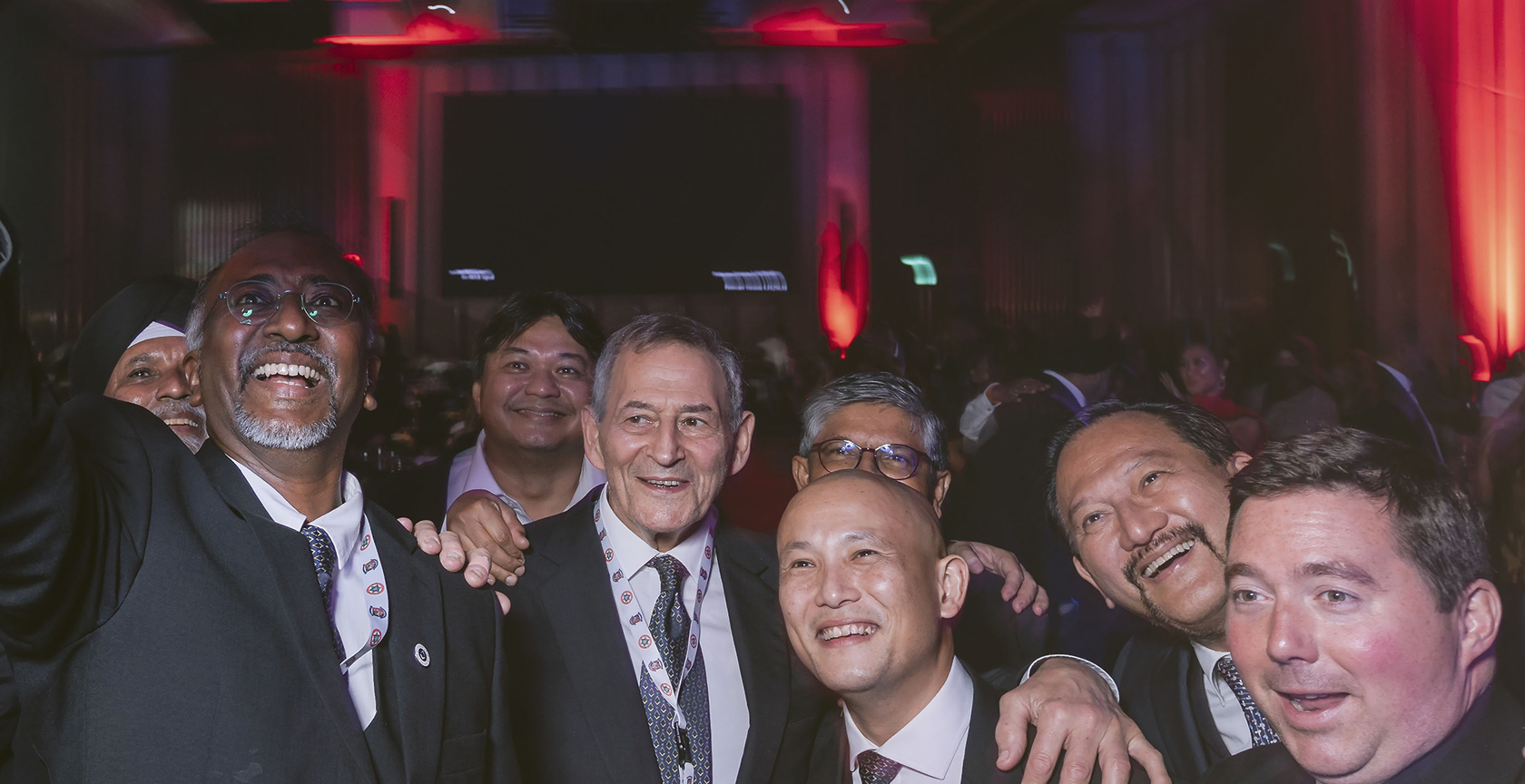
The diversity of the District is a wonderful source of comradeship. This is witnessed by the frequent visits from brethren to lodges across the three international borders. The strength of the District is on full display at the Half and Annual Communications of the District, with the festivals being rotated across different cities in the three countries, with often a quarter of the almost two thousand brethren congregating to enjoy each other’s company.
Some of the forty-three lodges work the revised ritual, while others work the emulation. While Thailand is home to seventy-one living Thai languages and Malay is the official language of Malaysia and Singapore, the rituals of all forty-three lodges are conducted in English. The temples also host lodges from the Scottish, Irish and French Constitutions. This adds to the vibrancy of the District, with brethren often being members of various constitutions. All lodges are registered in their respective countries under the local register of societies.
Take Your First Step
When you become a Freemason, you begin your journey toward being a better man. You will build rich, meaningful relationships with your Brothers, commit to the service of those around you, and strive for a deeper, more honest connection with yourself and others. It’s a journey of self-discovery and enlightenment.
Make a difference.
Find your truth.
Take Your
First Step
When you become a Freemason, you begin your journey toward being a better man.
You will build rich, meaningful relationships with your Brothers, commit to the service of those around you, and strive for a deeper, more honest connection with yourself and others.
It’s a journey of self-discovery and enlightenment.
Make a difference.
Find your truth.